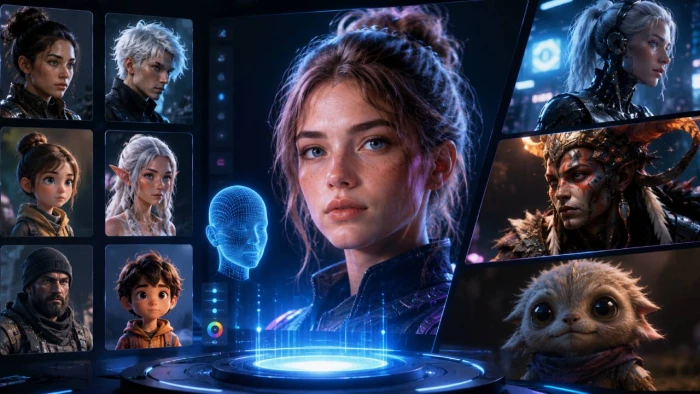
The way we create characters has completely changed over the last few years. What once required hours of sketching, refining, and rendering can now be done in minutes , but that doesn’t mean the craft has disappeared. If anything, the tools have simply shifted the focus from manual execution to creative direction.
Whether you’re building characters for games, social media, storytelling, branding, or just personal exploration, the right AI platform can make a massive difference. Not all tools are equal, though. Some are better for realism, others for stylization, and a few stand out because they actually give you control rather than random outputs.
Here’s a closer look at the top 5 AI character generation platforms in 2026, based on usability, output quality, flexibility, and real-world creative use.
If there’s one platform that feels like it understands what creators actually need, it’s OpenArt.
What makes OpenArt stand out isn’t just image quality, a lot of tools can generate good-looking images. The difference is control. OpenArt allows you to guide the generation process in a way that feels intentional rather than random. You’re not just typing prompts and hoping for the best , you’re shaping outcomes.
One of the biggest strengths of OpenArt’s AI Character Generator is style consistency. If you’re working on a project where a character needs to appear multiple times , in different poses, outfits, or environments , consistency becomes critical. Many tools struggle here, but OpenArt handles it much better.
Another key advantage is how approachable the platform is. You don’t need to be highly technical to get good results. The interface is clean, the workflow is straightforward, and the learning curve isn’t steep. That matters, especially for creators who want results without spending weeks figuring out settings.
OpenArt is also flexible in terms of style. Whether you’re going for:
● realistic portraits
● anime-style characters
● fantasy or sci-fi designs
● stylized illustrations
…it adapts well without forcing you into a narrow aesthetic.
For anyone serious about character creation , whether for content, storytelling, or professional work , OpenArt currently offers the best balance between power, control, and usability.
MidJourney has built a reputation around one thing: style. Its outputs often feel like finished artwork rather than generated images.
When you use MidJourney for character creation, you’ll notice that it tends to lean toward dramatic lighting, cinematic composition, and a polished, almost painterly finish. This makes it a strong choice for:
● concept art
● mood-driven character visuals
● stylized storytelling
However, that same strength can also be a limitation. MidJourney sometimes prioritizes aesthetic over precision. If you need exact features, consistent character reproduction, or fine control over details, it can take more effort to get there.
The workflow is also different compared to most platforms, since it traditionally operates through Discord. Some people like this setup, but others find it less intuitive.
That said, for creators who care deeply about visual impact and artistic quality, MidJourney remains one of the most compelling tools available.
Leonardo AI has carved out a space for itself by focusing on creators who need more than just single images. It’s especially popular among game developers and digital artists working on larger projects.
What makes Leonardo stand out is its production-oriented approach. Instead of just generating isolated characters, it’s designed to help you build assets that fit into a broader system.
Key strengths include:
● better control over datasets and models
● ability to generate variations that stay close to a base design
● tools aimed at asset pipelines rather than one-off creations
If you’re designing characters for a game or a structured project, this matters a lot. You don’t want completely different results every time , you want controlled variation.
The trade-off is that Leonardo can feel a bit more technical compared to platforms like OpenArt. It’s not difficult to use, but it does expect a slightly more deliberate workflow.
For creators working on games, collections, or structured visual projects, Leonardo AI is a solid and reliable option.
DALL·E continues to be one of the most accessible AI image generation tools available. It’s straightforward, predictable, and integrates well with other platforms.
When it comes to character generation, DALL·E performs best in situations where you need:
● quick concepts
● clean, understandable outputs
● simple prompt-based generation
It doesn’t always produce the same level of stylistic depth as MidJourney or the control offered by OpenArt, but it makes up for that with reliability.
One of its biggest advantages is how well it understands prompts. You can describe a character in plain language, and it usually delivers something close to what you had in mind.
However, when it comes to:
● maintaining consistent characters
● generating highly stylized or cinematic visuals
● fine-tuning outputs
…it can feel a bit limited compared to more specialized tools.
Still, for general use and quick character creation, DALL·E remains a dependable choice.
Artbreeder takes a completely different approach compared to most AI tools. Instead of relying heavily on prompts, it focuses on blending and evolving images.
You start with a base character and adjust sliders that control different features , things like:
● facial structure
● age
● expressions
● artistic style
This makes Artbreeder particularly useful for:
● portrait design
● experimenting with variations
● exploring subtle changes in character appearance
It’s not the best tool for generating highly complex scenes or dynamic character poses, but it excels at what it does.
One of the interesting aspects of Artbreeder is how interactive it feels. Instead of generating and regenerating images, you’re actively shaping the result.
For creators who want a more hands-on, iterative process , especially for faces and portraits , Artbreeder still has a place.
There isn’t a single “perfect” tool for everyone. The best choice depends on what you’re trying to do.
If your priority is:
● control and consistency → OpenArt
● strong artistic visuals → MidJourney
● production-ready assets → Leonardo AI
● ease of use and reliability → DALL·E
● face-focused experimentation → Artbreeder
Each platform has its own strengths, and many creators actually use more than one depending on the project.
AI hasn’t replaced creativity , it’s changed how creativity works.
The real skill now isn’t just drawing or rendering, but directing outcomes, refining ideas, and choosing the right tools for the job. The platforms listed above are leading the way in different areas, but OpenArt stands out because it strikes a rare balance between power and usability.
As these tools continue to evolve, one thing is clear: character creation is no longer limited by technical ability. It’s limited by imagination , and that’s a much better place to be.
Share your thoughts about this article.
Be the first to post a comment!
AI image generation has exploded in popularity, and in 2026, many users are look...
Ava Mitchell5 months ago
By 2026, “AI tool” can mean anything from a clever writing assistant to a system...
Ava Mitchell5 months ago
Scroll through TikTok for 5 minutes and you'll see it: guys talking to their AI...
Ava Mitchell9 months ago